

You can pursue a PhD in any field you choose. To enroll in a PhD program, you need a master’s degree. The PhD process involves selecting a research topic and conducting in-depth research. Before starting a PhD, candidates should learn about the available specializations. Read the article to know everything about PhD specialization.

What is a PhD program?
A PhD, or Doctor of Philosophy, is a high-level academic degree. It is a doctorate degree too. It usually takes 3-4 years to complete but can extend up to five to six years. The duration may vary by college or institute.To pursue a PhD, you need a master’s degree. The PhD process involves selecting a research topic and conducting in-depth research. you must submit a conclusion at the end of your research. PhD candidates can choose any field of specialization.
Before starting, they should review the list of available PhD specializations. Refer to the article for the list of PhD specializations. Also Read | What is PhD full words?
Who can all apply to a PhD program?
To pursue a PhD, you must have a master's degree in the same field. Some colleges also require an MPhil. Many colleges accept candidates who have passed the UGC NET. For a PhD in Engineering, a valid GATE score is needed.
What are some specializations that we can choose?
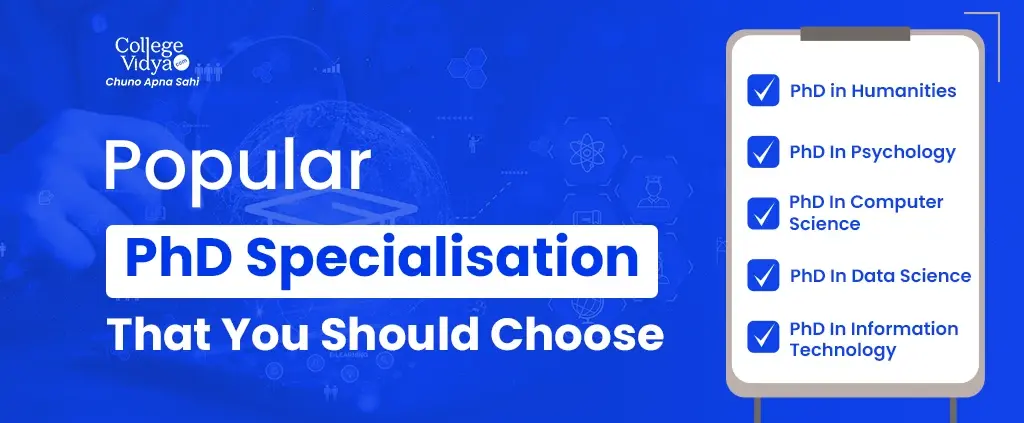
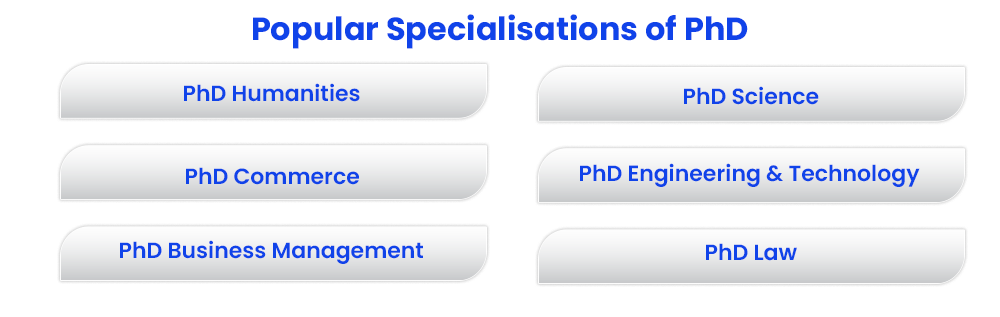
Here are some specializations are mentioned that you can choose from:
| specializations | |
|
PhD Humanities |
Designed to focus on human thoughts. Can contribute to policy development, analysis, and communications. |
|
It is focused on clinical psychology and social psychology. | |
|
It is focused on computer networks, cyber security, and Machine learning. | |
|
It is focused on the development of mathematical and statistical algorithms, software, and computing systems to extract knowledge or insights from data. | |
|
It is focused on information systems, cyber security, data analytics, and Artificial Intelligence (AI). | |
|
PhD Science |
Focuses on experiments and observations in science. Includes subfields like astrophysics, chemistry, and mathematics. |
|
Focuses on developing expertise in the areas of recruitment, training, compensation, benefits, and employee relations. | |
|
Focuses on subfields like accounting, finance, taxation, and banking. Contributes to financial policies and economic development. | |
|
PhD Engineering and Technology |
Focuses on solving complex computing problems and developing new computing languages, tools, and methods. Explores various subfields of engineering and technology. |
|
Focuses on tasks involved in running a company. Helps gain the management skills needed to run a business. | |
|
Focuses on research and teaching in legal studies. Subfields include international law, human rights, and environmental law. | |
Stream-wise specializations of a PhD Program
You can focus on science-related subjects like biology, chemistry, or physics. Specializations in civil, mechanical, or computer engineering are available in engineering.Within the humanities and arts, one might specialize in philosophy, history, or literature. Specializations in business include marketing, management, and finance. Economics, psychology, and sociology are among the specialties available in the social sciences.
Human rights, environmental law, and international law are the main topics of legal studies. Each stream enables in-depth study and subject-matter knowledge.
|
Popular PhD courses in Humanities | ||
|
PhD in Humanities |
PhD Economics |
PhD Geography |
|
PhD in Social Work |
PhD in English |
PhD in Social Sciences |
|
PhD in Public and Economic Policy |
PhD in Humanities & Social Sciences |
PhD in Humanities and Life Sciences |
|
PhD in Psychology |
PhD in Arts |
PhD in International Relations and Politics |
|
PhD in Physiology |
PhD in Public Policy |
PhD in Literature |
|
Popular PhD Courses in Science | ||
|
PhD in Chemistry |
PhD in Clinical Research |
PhD in Science |
|
PhD in Bioscience |
PhD in Bioinformatics |
PhD Biotechnology |
|
PhD in Mathematical and Computational Sciences |
PhD in Environmental Science and Engineering |
PhD in Applied Chemistry & Polymer Technology |
|
PhD in Applied Sciences |
PhD Zoology |
PhD in Physics |
|
PhD in Basic and Applied Sciences |
PhD in Mathematics |
PhD in Zoology |
|
Popular PhD Courses in Commerce | ||
|
PhD in Commerce Management |
PhD in Accounting and Financial Management | |
|
Popular PhD Courses in Engineering | ||
|
PhD in Engineering |
PhD in Genetic Engineering |
PhD in Civil Engineering |
|
PhD Program in Quantitative Techniques |
PhD in Engineering and Technology |
PhD Electronics & Communication Engineering |
|
PhD Computer Science Engineering |
PhD in Electronics and Communication Engineering |
PhD in Aeronautical and Automobile Engineering |
|
PhD in Information Technology |
PhD in Ceramic Engineering |
PhD in Production Engineering |
|
PhD in Marine Biotechnology |
PhD in Chemical Engineering |
PhD in Mechanical Engineering |
|
Popular PhD Courses in Business & Management | ||
|
PhD Business Administration |
PhD in Management |
PhD in Aviation Management |
|
PhD in Logistics and Supply Chain Management |
PhD in Accounting and Financial Management |
PhD in Marketing/ Brand Management |
|
PhD in Commerce |
PhD in Commerce and Management | |
|
Popular PhD Courses in Law | ||
|
PhD in Law |
PhD in Constitutional Law |
PhD in Law and Governance |
|
PhD in Legal Studies | ||
|
Popular PhD Courses in Teaching & Education | ||
|
PhD in Education |
PhD in Teaching | |
Stream-wise Syllabus of PhD
Courses for Doctor of Philosophy, or PhD, are available in several subjects. The arts and humanities, science, and management are a few of the main streams.
In India, there are several PhD programs accessible. The syllabus for a few PhD courses is broken down per stream in the table below:
- Science Stream: In order to find fresh ideas for their thesis, PhD science students must do experiments, observe, question, model, and study. Students who complete the course are prepared for jobs in teaching and learning strategies across a variety of scientific fields. With an emphasis on research, the subjects covered include physics, chemistry, biology, computer science, and life sciences. Material science and geophysics could be covered. Students are required to complete coursework covering key ideas and concepts at the start of the course. Students work independently on research projects after class, and at the conclusion of the semester, they turn in a thesis.
Check the table below to know the topics you will get to learn in the science stream:
| Learn in the science stream | |
|
Advanced Computer Algorithms |
Distributed COM |
|
Advanced Database Management Systems |
Distributed File System |
|
Advanced Software Engineering |
Distributed Systems |
|
Component Object Model (COM) & interfaces in COM |
Dynamic Programming |
|
Computer Architecture |
Frequencies for Radio Transmission |
|
Computer System Design |
Medium Access Control |
|
CORBA, JAVA, and object web |
Multiprocessor Architecture |
Management Stream: You can obtain an academic and research position with a PhD in management. You can work at academic institutions as a professor or researcher. You can also work in corporate environments as a management consultant, policy analyst, or business specialist.
Check the table below to know the topics you will get to learn in the Management stream :
| learn in the Management stream | |
|
Computer Applications |
Logistics |
|
Dissertation |
Marketing |
|
Elective I |
Operations Management |
|
Financial Management |
Project Work |
|
General Management |
Quantitative Analysis |
|
Human Resource Management |
Research Methodology |
|
Information Technology Management |
Retail Merchandising |
Art and Humanities Stream: You obtain advanced abilities for professions in the humanities and arts. A dissertation based on the student's study topic is required. Their expertise gives them an extensive understanding of many art styles, history, and methods. Perfect for those who are enthusiastic and inventive. Visual arts, music, history, English literature, psychology, and other fields are among the specializations. Graduates can work at research institutes, colleges, and universities as instructors and researchers.
Check the table below to know the topics you will get to learn in the Art and Humanities stream :
| Learn in the art and humanities stream. | |
|
Advanced Course in Logic |
Communication Theory |
|
Advanced Course in Philosophy of Science |
Data Collection and Organization |
|
Advanced Course in Formal Methods |
Decision Theory |
|
Advanced Econometric Methods |
Environment and Development |
|
Advanced Economic Theory |
Environmental Philosophy |
|
Advanced Macroeconomics Theory |
Fieldwork |
|
Advanced Microeconomics Theory |
Governance and the Political Economy of Development |
PhD Specialisations After MBA
A PhD in Business is a doctoral-oriented course that focuses on running a company. This includes activities such as implementing, leading, managing, planning, and organizing. The course duration is three years.
Moreover, a PhD in Business Management after an MBA would be the right choice for you. Activities include fundraising, accounting seminars, global business seminars, financial theory, advanced accounting theory, seminars on banking, and strategic media planning.
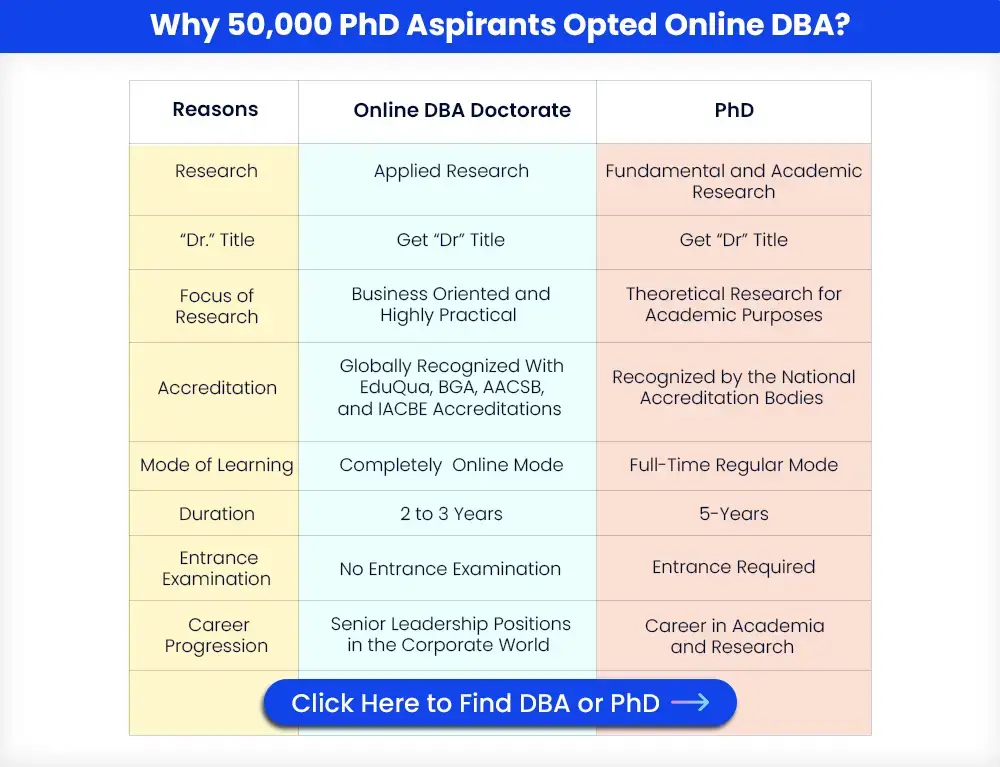
Moreover, if you do not want to quit your job and want to get recognized by the “Dr” title before your name, then you can opt for its alternative named DBA online course. It stands for a Doctor of Business Administration and it is also a doctorate program that adds up the "Dr." title before your name.
Moreover, if you choose an Online DBA, you will be able to get your doctorate from an international university without even relocating to a foreign country. Moreover, in an Online DBA, you will get an opportunity to learn from international faculties who have years of experience and have published their work in top journals.
Many universities offer you an online DBA; some of them are mentioned below:
- Golden Gate University Online
- Rushford Business School Online
- ESGCI International School of Management Paris Online
What are some Popular Entrance Exams conducted for PhD?
There are a variety of popular exams available for Ph.D. Some of them are explained below and it is important to customize your approach to the specific test you are aiming for.
Here are some tips on a few basic tests :
- UGC NET: This exam tests your subject knowledge, research aptitude, and teaching skills. Stay updated with the latest developments in your field, practice analytical reasoning, and familiarize yourself with the exam pattern.
- GPAT: This Graduate Pharmacy Aptitude Test is for Ph.D. programs in pharmacy. It strengthens your understanding of pharmaceutical sciences, focus on problem-solving, and practice mock tests to excel.
- JEST: This Joint Entrance Screening Test is for integrated Ph.D. programs in various scientific disciplines. Emphasize your conceptual understanding of the subject, practice analytical reasoning, and brush up on your mathematical skills.
- CSIR NET: This Council of Scientific and Industrial Research – National Eligibility Test is for research fellowships and Ph.D. admissions. Develop a deep understanding of the subject, practice critical thinking, and stay updated on the latest research trends.
- GATE: The Graduate Aptitude Test in Engineering is for M.Tech. and Ph.D. programs in engineering and technology. Strengthen your understanding of engineering principles, practice problem-solving, and become acquainted with the exam format.
What is the Admission Procedure for a PhD Program?
PhD admissions are primarily based on entrance tests followed by a personal interview by the university. These tests can be national-level like UGC NET, CSIR NET, GATE, SLET, or university-specific exams. Reservations for SC/ST/EWS/OBC NCL/PwD candidates are provided as per government regulations.
What do we need to prepare for a PhD Entrance Exam?
The syllabus for PhD entrance exams is based on the candidate's chosen specialization. It majorly includes topics from their UG and PG courses. Many universities also conduct an interview round for PhD admissions.
|
PhD Subjects |
Entrance Exam Syllabus |
|
Life Sciences |
|
|
Mathematics |
|
|
Basic Engineering and Technology |
|
|
Computer Information Science |
|
|
Political Science |
|
|
Economics |
|
|
Psychology |
|
How can I prepare for an entrance exam?
It's quite easy; all you need to do is make a study plan and work on it every day, and when you've carried it out well, you'll be able to get your PhD. Always create a study schedule that outlines what you will study and when and helps you reach your daily objectives.
Moreover, attempt as many admission examinations from prior years as you can. Aim to prepare in accordance with the specialization's PhD entrance test syllabus. Prepare in advance to give yourself ample time for editing. Practice with different simulated exams. Keep abreast with current events.
Universities Offering a PhD Program?
Various government and private colleges are offering a PhD program, Some of them are mentioned below. Moreover, you can also check the entrance exam accepted in these colleges and universities.
|
Institute |
Exams Accepted |
|
Jawaharlal Nehru University |
UGC NET-JRF |
|
University of Delhi |
NET/JRF |
|
Hidayaullah National Law University |
Entrance Exam, UGC NET JRF |
|
Aligarh Muslim University |
University Entrance Exam, UGC NET JRF |
|
Mizoram University |
University Entrance Exam, UGC NET JRF |
|
North Eastern Hill University |
Entrance Exam, UGC NET JRF |
|
Amrita Vishwa Vidyapeetham |
GATE |
|
Manipal University PhD |
PhD Manipal Entrance Test (MET) |
|
VIT Vellore |
VITREE |
|
KIIT University |
KIITEE |
|
BITS PhD Entrance Exam | |
|
Bharathidasan University |
University-Level Exam |
Course Structure of PhD Programs In India
- After getting selected for PhD courses, candidates are required to submit their research plan and research subject. They are then assigned a research mentor or supervisor.
- Candidates get details on the course syllabus, assessment procedures, and teaching schedule. Most institutes need biannual progress reports on their research initiatives.
- PhD applicants must submit a certificate to the Research Unit and present in at least two seminars throughout their research period. In addition, you have to produce at least one research paper in a peer-reviewed journal and submit a certificate to the research unit before presenting your thesis.
- The supervisor will schedule a Pre-submission Seminar before the thesis is turned in. This seminar will compile improvement recommendations.
- An advance submission The supervisor will schedule a seminar before the thesis is turned in. This seminar will gather suggestions for improvement, which the applicant must include in their final thesis.
- Candidates are required to submit a thesis summary 45 days before the final submission. The thesis is turned in both hard copy and soft copy and is reviewed by independent experts. If any revisions are suggested, the applicant must submit a new version of the thesis.
- Lastly, during a viva voce, candidates present their theses for defense to a panel of experts. Once these conditions are met, the candidate receives a PhD.
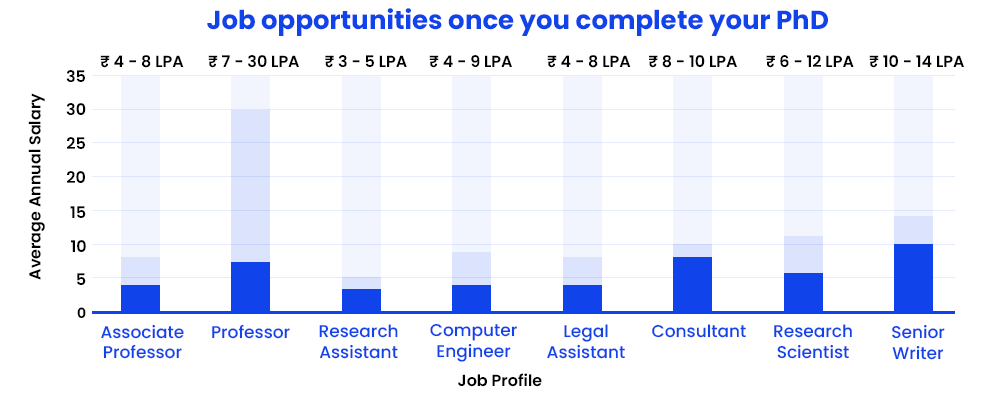
What is Next After PhD Program: Job Opportunities and Professions
There are various options for you once you complete your PhD:
- Postdoctoral Fellowship: If you want to continue research, do a postdoctoral fellowship at an academic institution. This pathway can lead to a tenure-track professorship and the opportunity to establish your own research lab. But this is not the only career option after a PhD.
- Explore industry: If academic is not your passion, join the industry directly or after obtaining a postdoctoral fellowship. Transitioning into the industry requires an understanding of work habits and cultures, but this is often part of training new employees. You can explore roles in sales and marketing, product development, and business development within the business.
- Book Support: If you want to be directly involved in research rather than doing research, consider a career in publishing. You can work with publishers, journals, scholarly communication specialists, or organizations.
- Science Journalism and Social Communication If you are interested in communication and want to bridge the gap between science and society, consider a career in science journalism or communication. Explore organizations involved in science dissemination and social networking.
The Alternative of a PhD Program
If a PhD degree isn't what you're looking for, you may also pursue an online DBA program, which is a doctoral program that puts a "Dr." title before your name. It also gives you a number of benefits, like the ability to avoid going to college every day. While a PhD requires a minimum of 5-7 years to complete, an online DBA can be completed in as little as 3-5 years. Additionally, worldwide faculties instruct you in an online DBA program.
An online DBA is offered by several colleges. A few of them are listed below:
|
Universities |
Fees |
|
INR 8,14,000 | |
|
INR 8,12,500 | |
|
INR 8,14,000 |
Top Trending Articles
Conclusion
In summary, obtaining a PhD provides access to advanced knowledge and proficiency in a variety of disciplines, such as science, business, the humanities, engineering, law, and management. The curriculum usually lasts three to four years, however this might change. PhD candidates do in-depth study and then present a thesis that summarizes their conclusions. Diverse specializations are available to meet the hobbies and professional goals of each individual. Entrance examinations, interviews, and fulfilling eligibility requirements are all part of the admissions process. A PhD can lead to competitive salary and employment prospects as well as academic, research, and professional opportunities. Even if the path could be difficult, there are significant benefits that open doors for both career and personal development.