

The full form of a PhD is Doctor of Philosophy, and it is a doctoral program. The duration to complete the program is a minimum of 3-5 years and you extend up to 7 years. It also stands for DPhil or D.Phil in some countries. A PhD holder can use the title 'Dr..' before their name.

It's considered the highest level of qualification in many fields. The program involves years of study, research, and publishing work. Completing a PhD typically requires coursework, exams, and a thesis. It usually takes at least three years to complete a PhD.
What is the objective of a PhD program?
A PhD is a prestigious academic degree offered by universities worldwide. Its main aim is to train the future generation of researchers and scientists.Students with a PhD have many opportunities in today's world. After earning their degree, they should assess their skills and apply for jobs based on their interests and expertise. Knowing their area of interest helps them find a suitable job.
PhD holders can work as lecturers or professors in human services, as novelists or writers, journalists, editors, critics, philosophical journalists, researchers, scientists, or independent consultants. They can find roles in various sectors, from finance to the public sector.
Skills Needed for a PhD Degree
PhD stands for Doctor of Philosophy in education. Doing a PhD is not easy—it needs many important skills to handle the hard work of research and learning.
The first and most important skill is having a strong desire to learn. You must be curious and ready to explore new ideas. You should not be afraid of mistakes. Even when the results are not what you expected, they are still useful. This helps you stay positive and strong during tough times.
- Time management is also very important. A PhD student needs to plan their time well so they can do research and experiments without getting too tired or stressed. You have to be productive even when time is short.
- Another big part of PhD work is data analysis. You have to look at data carefully, find patterns, and make good conclusions. Even though there are software tools to help, your own thinking and judgment are still very important to understand what the data means.
- Communication skills are also needed. You must explain your research clearly in writing (like in research papers), speaking (at presentations), and in everyday conversations, especially during seminars and conferences. Good communication also helps you build connections with other people in your field.
- One more key skill is perseverance—that means not giving up easily. A PhD journey has many ups and downs. Sometimes, things don’t go as planned. But if you stay patient and keep trying, you will move forward.
In short, doing a PhD means learning how to manage your time, study deeply, analyze data, communicate well, and keep going even when things are hard. These skills not only help you complete your PhD but also prepare you for a great career ahead.
What are the eligibility criteria to pursue a PhD program?
To pursue a PhD program, you must fulfill the eligibility criteria mentioned below:
- To pursue a PhD, a master's degree in the same field is necessary.
- Some universities may require an MPhil as well.
- Colleges accept candidates who have cleared UGC NET.
- Candidates in Engineering must have a valid GATE score.
PhD Entrance Exams
If you want to study for a PhD in India, you usually need to pass an entrance exam. These exams check how much you know about your subject and how ready you are for research. Here are some of the main PhD entrance exams in India:
National Level Exams
- UGC-NET: This exam is managed by NTA. It is for subjects like humanities, social sciences, and commerce.
- CSIR-NET: This is for science subjects like physics, chemistry, maths, life sciences, and earth sciences. It is managed by CSIR.
- GATE: This exam is for students who studied engineering or technology. It is used for PhD admissions and also for jobs.
- JRF-NET: This exam gives research fellowships in special fields. It is conducted by groups like ICMR, DBT, and ICAR.
University-Specific Exams
Some universities also conduct their own entrance exams. These can include:
- A written test
- An interview
These tests are held by the university for specific subjects or departments.
In short, to get a PhD seat, you must pass one of these exams, depending on your subject.
What is the UGC-NET exam?
The CSIR UGC NET is an entrance exam for Indian nationals to qualify for Junior Research Fellowships and Lectureship or Assistant Professor positions in Indian universities and colleges. Candidates must meet the eligibility criteria set by UGC.
Some of the important dates regarding the PhD Entrance Exam are mentioned below:
|
Entrance Exam |
Registration Date |
Exam Date |
|
UGC NET |
To be Announced |
June 10 – June 21, 2026 |
|
CSIR NET |
To be Announced |
To be Announced |
|
IPU PhD Entrance Test (PET) |
March-May, 2024 |
June, 2026 |
|
GATE |
August 31 – October 13, 2023 |
February 3, 4, 10, 11, 2026 |
|
VITMEE |
November 30, 2023 |
December 12, 2026 |
|
AIIMS Ph.D Entrance Exam |
To be Announced |
To be Announced |
|
VMOU PhD Entrance Exam |
To be Announced |
To be Announced |
|
NIPER PhD Entrance Exam |
To be Announced |
To be Announced |
PhD Entrance Exam Syllabus of Delhi University
The entrance exam of Delhi University for PhD is divided into 2 parts. Each part holds a weightage of 50 percent marks.
| PhD Entrance Exam Syllabus of Delhi University | |
|
Research Methodology |
|
|
Mathematical Tools for Research in Computer Science (part of Research Methodology) |
|
|
English Comprehension |
|
|
Computer Science (Subject Specific) |
|
What are those subjects in which a PhD degree is offered?
There are various subjects that can be opted for by you if you are thinking of pursuing a PhD program.
Some of those subjects are mentioned below:
|
Some of those subjects are mentioned | |
|
|
What is the admission procedure for a PhD program?
Follow the simple steps below to learn the admission procedure of a PhD Program :
- Visit the university’s official website and review the PhD course details. Select your research area.
- Watch for admission advertisements in newspapers or on the university's website. Fill out the application form for your chosen course. Admission notifications are usually released 4-5 months before the course starts.
- Fill out and submit your application form as per the institute's schedule. Ensure you pay the application fee on time and submit all required documents.
- Some institutes require a research proposal with the application form. Submit the application form and research proposal to the Research Unit for review.
- After reviewing the applications, institutes shortlist candidates for entrance exams and other admission rounds.
- Candidates selected for PhD programs are assigned supervisors or guides for their research.
What is a PhD research proposal?
A research proposal outlines the direction of your future research, focusing on a research question and a chapter-by-chapter approach to addressing it. In PhD applications, the proposal is evaluated to determine if the project can be completed within three years of full-time research.
What to include in your research proposal?
- Outline your proposed research topics, considering previous work.
- Highlight your awareness of current debates within the field.
- Demonstrate a suitable level of analysis.
- Identify relevant gaps in current knowledge.
- Suggest a research hypothesis to fill some of these gaps.
- Explain your intended research methodology in detail.
- Discuss the real-world policy implications of your PhD proposal.
What are Some of the popular PhD Programs?
Some of the popular PhD programs according to the streams are written below. You can choose anyone of your choice.
|
Popular PhD courses in Humanities | ||
|
PhD in Humanities |
PhD Economics |
PhD Geography |
|
PhD in Social Work |
PhD in English |
PhD in Social Sciences |
|
PhD in Public and Economic Policy |
PhD in Humanities & Social Sciences |
PhD in Humanities and Life Sciences |
|
PhD in Psychology |
PhD in Arts |
PhD in International Relations and Politics |
|
PhD in Physiology |
PhD in Public Policy |
PhD in Literature |
|
Popular PhD Courses in Science | ||
|
PhD in Chemistry |
PhD in Clinical Research |
PhD in Science |
|
PhD in Bioscience |
PhD in Bioinformatics |
PhD Biotechnology |
|
PhD in Mathematical and Computational Sciences |
PhD in Environmental Science and Engineering |
PhD in Applied Chemistry & Polymer Technology |
|
PhD in Applied Sciences |
PhD Zoology |
PhD in Physics |
|
PhD in Basic and Applied Sciences |
PhD in Mathematics |
PhD in Zoology |
|
Popular PhD Courses in Commerce | ||
|
PhD in Commerce Management |
PhD in Accounting and Financial Management | |
|
Popular PhD Courses in Engineering | ||
|
PhD in Engineering |
PhD in Genetic Engineering |
PhD in Civil Engineering |
|
PhD Program in Quantitative Techniques |
PhD in Engineering and Technology |
PhD Electronics & Communication Engineering |
|
PhD Computer Science Engineering |
PhD in Electronics and Communication Engineering |
PhD in Aeronautical and Automobile Engineering |
|
PhD in Information Technology |
PhD in Ceramic Engineering |
PhD in Production Engineering |
|
PhD in Marine Biotechnology |
PhD in Chemical Engineering |
PhD in Mechanical Engineering |
|
Popular PhD Courses in Business & Management | ||
|
PhD Business Administration |
PhD in Management |
PhD in Aviation Management |
|
PhD in Logistics and Supply Chain Management |
PhD in Accounting and Financial Management |
PhD in Marketing/ Brand Management |
|
PhD in Commerce |
PhD in Commerce and Management | |
|
Popular PhD Courses in Law | ||
|
PhD in Law |
PhD in Constitutional Law |
PhD in Law and Governance |
|
PhD in Legal Studies | ||
|
Popular PhD Courses in Teaching & Education | ||
|
PhD in Education |
PhD in Teaching | |
What are the types of research scholars?
- Government or Semi-Government Fellowship Recipients: PhD scholars in this category receive financial assistance through government or semi-government fellowship schemes.
- Institute Research Scholars with Teaching Assistance: PhD aspirants in this category receive Institute Teaching Assistantships as specified by the MHRD. Indian Self-financed Candidates: These candidates are admitted to PhD programs based on their track record and experience, but they do not receive financial assistance from the institute.
- Foreign Self-financed Candidates: Admission for these candidates is facilitated through their respective country's embassy after obtaining a no-objection certificate from the MHRD and other necessary approvals.
- Sponsored Candidates: PhD aspirants sponsored by recognized Research and Development organizations conduct full-time research at the institute.
- Study Leave Candidates: These candidates are granted study leave by their government institutes, companies, or educational institutions for research at the specified institute for less than three years. A letter of leave from the candidate's institute or company is required for admission.
- ICCR Awardees: Foreign candidates sponsored by their governments are awarded PhD seats under the Indian Council of Cultural Relations (ICCR) scholarship category if they have been awarded the scholarship by their government.
What are the advantages of pursuing a PhD program?
Students with a Doctor of Philosophy (PhD) have many opportunities. After earning their degree, they should assess their skills and interests to find suitable jobs. Knowing their interests helps in finding a good job.
PhD holders can work as lecturers or professors in human services, as novelists or writers, journalists, editors, or critics, as philosophical journalists, researchers, scientists, or independent consultants. They can work in finance, public sector, and more.
|
UG & PG Programs Details Guide | |
Stream-wise Syllabus of PhD Program
PhD or Doctor of Philosophy, offers courses in many fields. Some major streams include Science, Arts and humanities, and management. There are many PhD courses available in India. The table below shows the syllabus for some PhD courses by stream:
Check the table below to know the topics you will get to learn in the science stream:
| Learn in the Science Stream | |
|
Advanced Computer Algorithms |
Distributed COM |
|
Advanced Database Management Systems |
Distributed File System |
|
Advanced Software Engineering |
Distributed Systems |
|
Component Object Model (COM) & interfaces in COM |
Dynamic Programming |
|
Computer Architecture |
Frequencies for Radio Transmission |
|
Computer System Design |
Medium Access Control |
|
CORBA, JAVA, and object web |
Multiprocessor Architecture |
Management Stream: Check the table below to know the topics you will get to learn in the Management stream
|
Computer Applications |
Logistics |
|
Dissertation |
Marketing |
|
Elective I |
Operations Management |
|
Financial Management |
Project Work |
|
General Management |
Quantitative Analysis |
|
Human Resource Management |
Research Methodology |
|
Information Technology Management |
Retail Merchandising |
Art and Humanities Stream: Check the table below to know the topics you will get to learn in the Art and Humanities stream
|
Advanced Course in Logic |
Communication Theory |
|
Advanced Course in Philosophy of Science |
Data Collection and Organization |
|
Advanced Course in Formal Methods |
Decision Theory |
|
Advanced Econometric Methods |
Environment and Development |
|
Advanced Economic Theory |
Environment Philosophy |
|
Advanced Macroeconomics Theory |
Fieldwork |
|
Advanced Microeconomics Theory |
Governance and the Political Economy of Development |
PhD Syllabus
The PhD syllabus is mainly about learning how to do deep research, studying advanced topics in your chosen subject, and creating a research proposal. It helps students become ready for independent research and writing a thesis.
Main Parts of a PhD Program
Most PhD programs have similar core parts, though the details may change depending on your subject and university.
Coursework
- You study advanced topics related to your subject.
- You learn research methods, data analysis, and statistics.
- You also learn about research ethics—what is right and wrong in research.
Research Proposal
- You write a plan for your research.
- It includes your main question, how you’ll research it, and what you expect to find.
Original Research
- This is the most important part.
- You collect data, study it, and try to answer your research question.
- It takes a lot of time and effort.
Thesis Writing
- You write a full report (called a thesis) about your research.
- It includes what you studied, how you did it, and what you found.
Thesis Defense
- After you finish your thesis, you must present and defend it in front of a group of experts.
What Affects the PhD Syllabus?
- Subject Area: Your syllabus depends on your chosen subject (e.g., Physics, Economics, English, etc.).
- University Rules: Each university has its own guidelines for PhD students.
- Supervisor’s Expertise: Your guide or supervisor will shape your research direction based on their knowledge.
- Your Interest: Your personal research topic also decides what you will study and write.
Final Tip: For exact details about a specific PhD course, it's best to check the university’s official website or talk to the department directly. They will tell you what subjects, research work, and steps you need to follow.
What is the course structure of a PhD Program?
- The research proposal and research topic must be submitted by candidates who are chosen for PhD programs. They are then given a research guide or supervisor.
- The coordinator or supervisor of the research program provides information on the courses, assessment procedures, and teaching schedule. Researchers are required to provide progress reports every six months.
- In addition to submitting a certificate to the Research Unit, PhD candidates are required to present in at least two seminars. Before turning in their thesis, they must furthermore present a certificate and at least one research paper that has been published in a peer-reviewed publication.
- The supervisor arranges a seminar before the submission of the thesis. The final thesis must take into account the suggestions for improvement made in this seminar.
- A thesis summary must be sent to the supervisor of the candidate at least forty-five days before the final submission. The thesis is then reviewed by outside specialists in both hard copy and soft copy versions. Should changes be recommended, the candidate is required to submit a revised thesis.
- Candidates present their theses before a panel of experts during a viva voce. A PhD degree is only granted to people who successfully finish all of these processes.
Who should opt for a PhD Program?
A Doctor of Philosophy degree is recommended for those who wish to work in academics or research (PhD). A PhD enables people to learn more about a subject they are passionate about. It gives those who deserve it a sense of pride and respect.
Students who are unsure about whether a PhD is suited for them may seek advice from teachers and previous PhD candidates. Understanding what PhD degrees include may be gained by investigating various PhD programs. Students who have a clear comprehension of the framework can decide whether or not to pursue a PhD.
Types of PhD Degrees
A PhD (Doctor of Philosophy) is the highest academic degree in any field. But did you know that there are different types of PhD programs based on your needs, schedule, and qualifications?
Let’s understand the most popular types of PhD degrees in India and how they are different from each other.
1) Full-Time PhD:
This is the most common and traditional type of PhD program.
Who is it for?
Students who want to do research as their main focus and can study full-time.
Key Features:
- You have to attend classes or research work at the university every day.
- Usually takes 3–6 years to complete.
- Many universities offer a monthly stipend (like ₹25,000 to ₹80,000).
- You must attend regular seminars, submit progress reports, and complete coursework.
Best for: Fresh postgraduates or those who want to become professors or scientists.
2) Part-Time PhD
This is perfect for people who are already working but still want to earn a PhD.
Who is it for?
Working professionals who can’t attend classes daily.
Key Features:
- Research can be done alongside your job.
- No need to attend classes every day.
- You have to visit the campus only occasionally (for seminars, discussions, or submitting reports).
- Takes a bit longer—usually 4 to 6 years.
Best for: Teachers, industry professionals, or anyone who wants to do research without leaving their job.
3) Online PhD
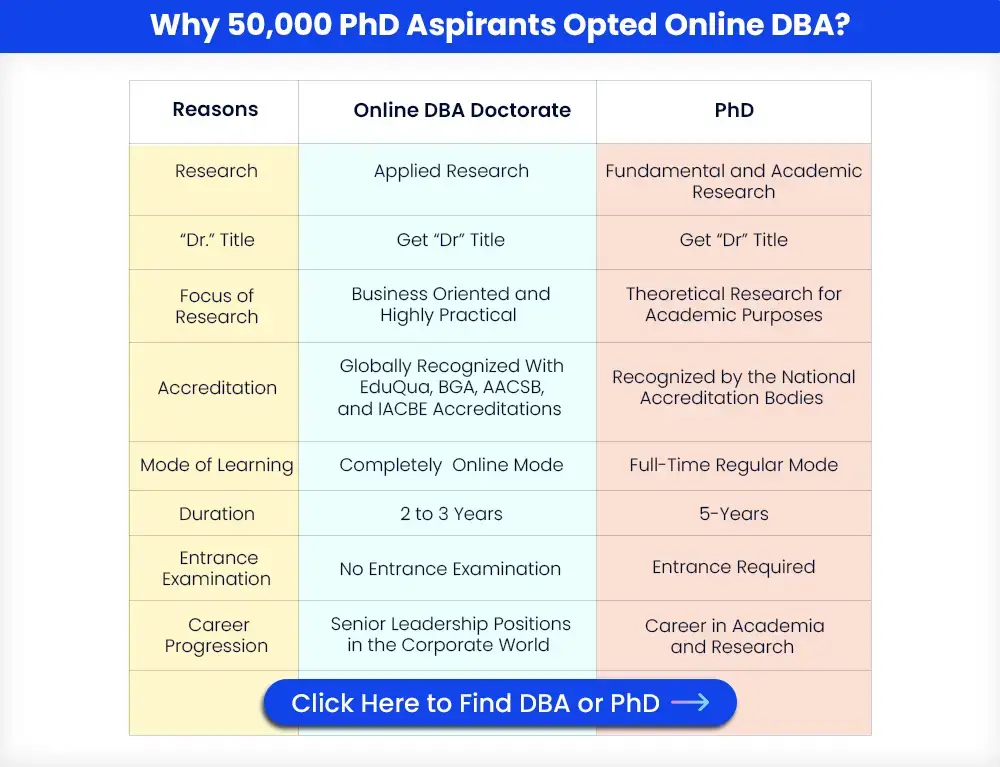
- Online PhD Program: Online PhD program is not UGC-approved in India and hence it is not offered by any Indian universities but if you are looking out for an option for an Online PhD program, you can opt for its alternative and that alternative is an Online DBA. It is also a doctorate program and it can be done online without visiting college daily. Moreover, it also adds up the “Dr” title before your name.
There are various universities offering you an Online DBA. Some of them are mentioned below:
|
Universities |
Fees |
|
INR 8,14,000 | |
|
INR 8,12,500 | |
|
INR 8,14,000 |
4) Integrated PhD
This is a combined program of a Master’s + PhD, done together.
Who is it for?
Students who want to enter research early after completing their undergraduate degree.
Key Features:
- Mostly offered in science and engineering fields.
- You get a master's degree and then continue into PhD.
- Saves time as you don’t have to apply separately for a PhD later.
- Usually takes 5–6 years to complete both.
Best for: Students who are sure they want to build a career in research and academics.
5) Direct PhD after BTech or Graduation
Some top institutes allow bright students to do a PhD directly after their bachelor’s degree.
Who is it for?
BTech, BE, or even BSc graduates with excellent academic records.
Key Features:
- You don’t need a Master’s degree.
- Usually offered by top IITs and IISc.
- A screening test and interview are required.
- Duration is longer—often 5 to 7 years.
Best for: High-performing students who want to dive into research early.
PhD for Working Professionals
This is specially designed for people who are already working in companies, teaching jobs, or government positions.
Who is it for?
People with jobs who want to improve their academic qualifications and career growth.
Key Features:
- Flexible timings and minimal campus visits.
- You can continue your job and still complete your PhD.
- Universities like IITs, IIMs, BITS Pilani (WILP), and many foreign universities offer such programs.
- You must show proof of work experience and a research proposal related to your field.
- Helps in promotions, salary hikes, or entering senior leadership roles.
Best for: Mid-level managers, teachers, researchers, and government employees.
Choosing the right type of PhD depends on your goals, current situation, and how much time you can give to research.
If you're a student with full-time availability, a Full-time PhD is best. If you’re working, you can go for a Part-time, Online, or Working Professionals PhD. And if you’re a fresh graduate or a top performer, you can explore Integrated or Direct PhD options.
Each type has its own value, and what matters most is your dedication and research interest.
PhD is not just a degree—it’s a journey of deep learning, innovation, and contribution to society.
|
Universities |
Fees |
|
INR 8,14,000 | |
|
INR 8,12,500 | |
|
INR 8,14,000 |
Colleges offering a PhD Program
There are various government and private colleges offering you a PhD Program. Some of them are mentioned below :
Government Colleges: Fees of government colleges are still less expensive than in comparison to private colleges.
|
College Name |
Fees (INR) |
|
JNU |
1391 |
|
Jai Narayan Vyas University |
10,000 |
|
BHU |
10,000 |
|
Jamia Millia Islamia |
15,000 |
|
Aligarh Muslim University |
10,000 |
|
DIPSAR |
30,385 |
|
NIT Durgapur |
64,100 |
|
Calcutta University |
14,000 |
|
Jadavpur University |
12,000 |
|
Institute of Advanced Study in Education |
3,116 |
Private Colleges : The fees of private colleges are a little high in comparison to the government colleges fees.
|
College Name |
Fees (INR) |
|
VIT |
53,000 |
|
Manipal Academy of Higher Education |
59,000 |
|
PRIST University |
30,000 |
|
DA-IICT |
65,000 |
|
Bombay College of Pharmacy |
1,50,850 |
|
Sri Ramachandra Institute of Higher Education |
25,000 |
|
IFHE Hyderabad |
1,20,000 |
|
IIIT-B |
1,07,000 |
|
JRNRVU |
30,000 |
|
BVIMSR |
75,000 |
NOTE - It is advised that you must check the fees before enrolling, as fees change from time to time.
What is the career scope after completing a PhD Program?
Once you complete a PhD program, you can apply to various job roles. Moreover, the “Dr” title will be added to your name.
Some of the job roles are mentioned below :
- Research Scientist (Government/Private Institutions)
- University Professor/Lecturer
- Postdoctoral Researcher (Postdoc)
- Science/Research Consultant
- Science Writer/Editor
- Data Scientist (Industry)
- Product Manager (Industry)
Check the table below to know the average salaries earned by the graduates of the program :
|
Job Title |
Average Salary (INR) |
|
Research Scientist (Government/Private Institutions) |
5 - 8 LPA |
|
University Professor/Lecturer |
7 - 15 LPA |
|
Postdoctoral Researcher (Postdoc) |
3.5 - 5 LPA |
|
Science/Research Consultant |
4 - 7 LPA |
|
Science Writer/Editor |
4 - 6 LPA |
|
Data Scientist (Industry) |
6 - 12 LPA |
|
Product Manager (Industry) |
8 - 18 LPA |
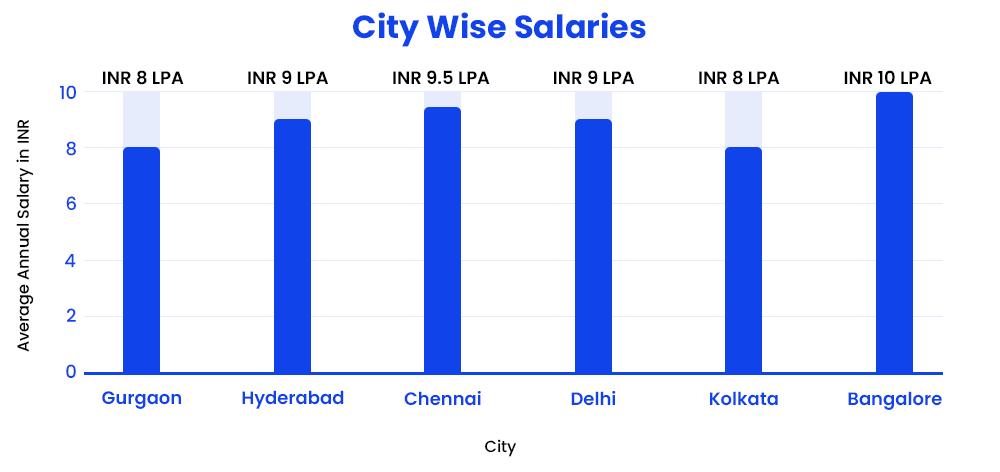
The average salary that you can earn after completing the program is INR 4,00,000 - INR 10,00,000. Salaries also depend upon factors such as location, company, experience, knowledge, and many more. It is to be noted that in some countries, a Doctor of Literature is considered above than PhD program.
Moreover, various top recruiters hire you once you complete your program. Moreover, the salaries of graduates of a PhD program according to the cities are mentioned below.
|
Top Research Organizations You Can Apply To | |
|
DRDO |
ISRO |
|
ICAR |
ASI |
Can I apply for a PhD without relevant qualifications?
If you lack the necessary qualifications for a PhD, you might still qualify by meeting additional requirements set by your chosen institution. These requirements could include extra study or passing a qualifying exam.Alternatively, you might make a special case to your institution based on non-degree professional qualifications or significant practical experience, or foreign qualifications.Special case PhD applications will need strong support from your potential supervisor, so seek their advice and backing before applying in this manner.
Is there a degree higher than a Ph.D?
Some degrees are considered higher than a PhD and are awarded for significant contributions in specific fields. These are common in UK and some European universities, often given as honorary degrees in the US.
Higher doctorate degrees include:
- Doctor of Science (DS/SD): Given for significant contributions to scientific knowledge beyond a PhD.
- Doctor of Literature/Letters (DLit/DLitt/LitD): Awarded for achievements in humanities or creative arts.
- Doctor of Divinity (DD): Recognizes ministry-oriented accomplishments, higher than a Doctor of Theology.
- Doctor of Music (DMus): Awarded based on a substantial portfolio of compositions or scholarly publications on music.
- Doctor of Civil Law (DCL): Among the highest doctorates, granted for exceptional and original contributions to law or politics.
PhDs through M.Phil
Potential PhD candidates have the option to apply as general research students or for an MPhil degree. The MPhil is an advanced master’s degree awarded for research, suitable for students without a strong research background. Candidates may need to take taught courses to learn research methods. Completion of a one-year taught program may lead to an MRes degree, with more taught components than the MPhil.
MRes can be awarded instead of a PhD if the required period of study for a PhD is not completed. Completion of original research may lead to the award of the MPhil degree without defending the dissertation. After the first or second year of research (during MPhil), if the institution is satisfied with progress, candidates can apply for full PhD registration. Supervisor or tutor determines readiness to progress to a PhD. Candidates develop a thesis title and choose a PhD program if deemed ready.
Scope of PhD
A PhD (Doctor of Philosophy) is the highest level of education. It shows that you have deep knowledge in a subject and can do original research. It also means you can think clearly, solve problems, and explain ideas well.
Career Options After a PhD
A PhD gives you many job choices in teaching, research, business, and more.
In Colleges and Universities (Academia):
- University Professor—Teach students and guide other PhD students.
- Research Scientist – Work in labs or universities to do research and write research papers.
- Post-Doctoral Fellow – Continue research after your PhD with the help of expert mentors.
In Companies (Industry)
- R&D (Research and Development) – Create new products or improve current ones.
- Consultant – Give expert advice to businesses or government.
- Policy Analyst – Help government bodies make smart policies.
- Data Scientist – Study data to help businesses make better decisions.
- Entrepreneur – Start your own business using your research idea.
Other Options:
- Writer or Editor – Write or edit scientific or academic content.
- Patent and IP Law – Work with laws that protect new inventions.
- Public Policy Expert – Use your knowledge to improve public systems and laws.
PhD Career Paths
|
Career Path |
Common Roles |
|
Academia |
Professor, Research Scientist, Postdoc Fellow |
|
Industry |
R&D Expert, Consultant, Data Scientist, Entrepreneur |
|
Other Opportunities |
Writer, Patent Law Expert, Policy Maker |
Benefits of Doing a PhD
- Deep Knowledge – Become an expert in your subject.
- Thinking Skills – Learn how to think better and solve problems.
- Research Skills – Learn how to do advanced research work.
- Job Options – Many career choices become open.
- Personal Growth – Builds confidence, patience, and curiosity.
PhD Salary in India
Your salary after a PhD depends on the following:
- Subject Area – Science and technology (STEM) jobs often pay more.
- Experience – New PhDs earn less than experienced ones.
- Employer Type – Government jobs, private companies, and colleges pay differently.
- City or Area – Big city jobs often offer higher salaries.
Average Salary:
A new PhD holder in India usually earns between ₹6 to ₹15 lakhs per year. With more experience or special skills, this can go even higher.Doing a PhD is a big step, but it opens many doors. Whether you want to teach, do research, work in business, or start something of your own, a PhD gives you the skills and knowledge to succeed.
Top Scholarships for PhD Students in India
Doing a PhD in India can be costly, but there are many scholarships to help students pay for their education and research. These scholarships come from the government, universities, and private organizations. Here are some of the top options:
Government Scholarships
- Prime Minister’s Research Fellowship (PMRF): This fellowship supports smart and talented students who want to do a PhD in different subjects. It gives financial help for research.
- UGC Fellowships: The University Grants Commission (UGC) offers fellowships to PhD students in many subjects. It helps with money for research and studies.
- CSIR Fellowships: The Council of Scientific and Industrial Research (CSIR) gives fellowships to students doing PhDs in science areas like physics, chemistry, biology, etc.
- DST Fellowships: The Department of Science and Technology (DST) supports students working in advanced science fields such as biotechnology, nanotechnology, and green energy.
- ICMR Fellowships: The Indian Council of Medical Research (ICMR) offers support to students who want to do research in medical and health-related fields.
University Scholarships
Many Indian universities have their own scholarships for PhD students. These can cover:
- Tuition fees
- Monthly living expenses (stipend)
- Research materials
These are usually given based on good academic performance, research ideas, or financial need.
Other Scholarships
- Tata Trusts: Offers scholarships for students pursuing higher education, including PhDs.
- Infosys Foundation: Supports research students in subjects like computer science, engineering, and mathematics.
- Fulbright-Nehru Fellowships: These fellowships give Indian students the chance to do a PhD in the United States with full or partial funding.
There are many helpful scholarships available in India for students who want to do a PhD. These programs reduce the cost of study and let students focus on their research. It’s a good idea to check the eligibility and apply early.
Conclusion
The full form of a PhD is a Doctor of Philosophy and it is a doctorate program. The duration to complete the program is a minimum of 3-5 years and you extend up to 7 years. It also stands for DPhil or D.Phil in some countries. A PhD holder can use the title 'Dr.' before their name. Moreover, if you want to pursue an Online PhD that is not approved by the UGC (University Grants Commission) you can opt for its alternative which is an Online DBA. It stands for Doctor of Business Administration and it is also a doctorate program and adds up the “Dr” title before your name.