


Quick Overview: The duration of a PhD program varies according to the country and the universities as well. In India, the period of a PhD is 3-6 years, and this is regardless of whether it is done in the IITs or not. You will need 5-7 years to obtain your PhD in the US, while in the UK, it takes 3-4 years.

Here are the PhD program durations of the respective countries. Institutions:
|
Country |
Duration |
Eligibility |
Program fees |
|
India |
3-6 Years |
Master's degree with 55–60% marks (varies by university) |
INR 50,000 – INR 3,00,000 (Public Universities); INR 3–10 Lakhs (Private Universities) |
|
IITs (India) |
4-6 Years |
Master's degree or exceptional B.Tech graduates (as per institute norms) |
INR 50,000 – INR 2.5 Lakhs (Tuition); many scholars receive stipends |
|
USA |
5-7 Years |
Bachelor's or Master's degree (depends on university) |
INR 19 – INR 57 Lakhs per year (many students receive full funding or assistantships) |
|
UK |
3-4 Years |
Master's degree or a strong Bachelor's degree (varies by university) |
INR 23 – INR 45 Lakhs per year (international students) |
Introduction
The ‘Doctor of Philosophy’ is the full form of the PhD degree. The aim of this Doctor of Philosophy research degree is academia and research. The highest degree in academia is a Ph.D. Usually, it takes 3-6 years to finish.
It might be finished more quickly with diligence and effective time management. A PhD can be obtained to work as a professor. You can also work for the government or in the private sector. PhD programs aim for completion in four to five years, but many students take longer due to dissertation research and writing.
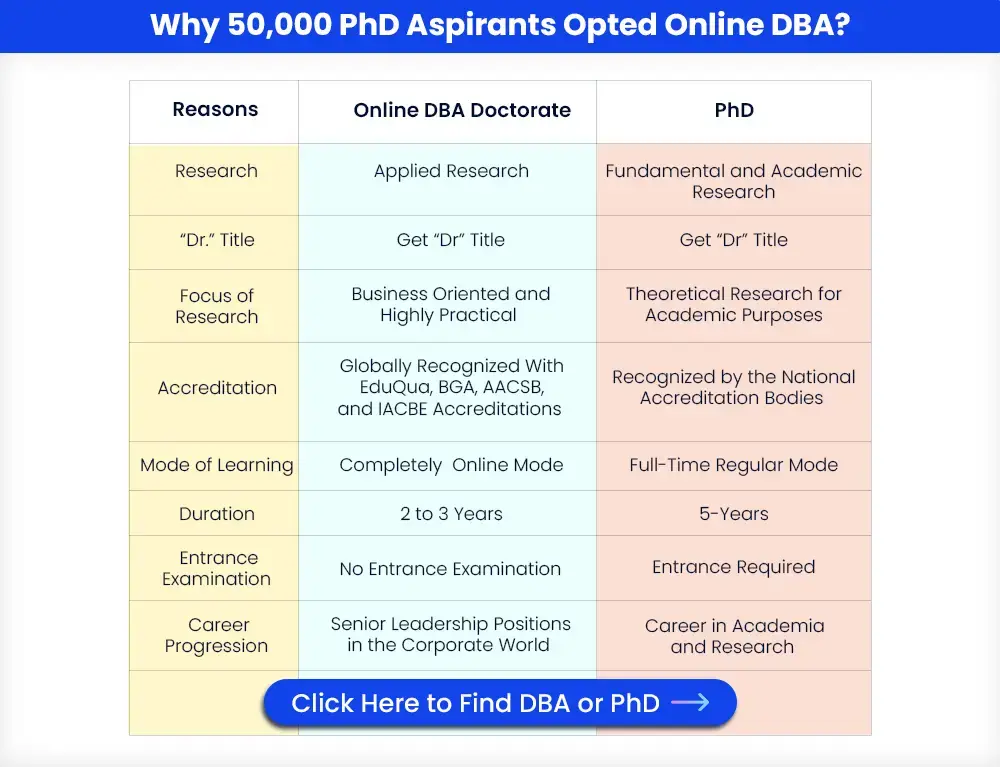
In 2020, doctoral students on average took six to twelve years to finish their PhDs. Do you know that if you opt for a PhD alternative, an online DBA, you will be able to complete your doctorate in a minimum of 3-5 years? DBA stands for Doctor of Business Administration, and it is also a doctorate program that adds the “Dr.” title before your name.
What is the duration of a PhD program in India?
The PhD degree in India usually takes anywhere between 3 to 6 years, and this is not something random since this is fixed in legislation. According to the UGC (Minimum Standards and Procedures for Award of Ph.D. Degree) Regulations, 2022 (notified on 7 November 2022), the duration of all PhD courses should be at least 3 years inclusive of coursework and a maximum of 6 years from the date of admission. The ones requiring an extra period of time are allowed to do that after applying for re-registration, which allows them to reach the period of 8 years; however, women and disabled candidates may have an additional 2 years relaxed.
The issue of government or private universities is another aspect which influences both the duration and cost of the program. Government universities have a stricter adherence to the 3-6 year timeframe fixed by UGC and have lower fee rates ranging from INR 50,000 to INR 3,00,000, though their places are fewer and the entrance tests like UGC NET are harder to clear. Private universities usually have more lenient time schedules to suit professionals, going on to reach near the upper limit of 6 years, but they cost much more, ranging from INR 3 to INR 10 Lakhs.
Also Read | Fees and Duration of Doctor of Business Administration!
What is the duration of a PhD program in the IITs?
The PhD duration at IITs typically takes 4-6 years to complete, as per the department and research area. Some of the major IITs are IIT Bombay, IIT Delhi, IIT Madras, IIT Kanpur, IIT Kharagpur, IIT Roorkee, and IIT Guwahati.
The majority of students pursuing their PhDs at IITs are provided with stipends through the UGC JRF, which grants a monthly stipend of ₹37,000 for two years, increasing to ₹42,000 for subsequent years as a Senior Research Fellow (SRF), along with HRA and a research contingency amount each year. Therefore, a funded IIT PhD is a very economical way of earning a doctorate, especially when taking into account the extremely low tuition fees and sufficient stipend.
Obtaining a PhD degree from a reputed institution such as IIT requires immense dedication, hard work, and research capability. Selection depends on many factors, including academic background, research aptitude, entrance examination marks (GATE or NET), and an interview.
Admission isn't solely based on previous college reputation. To boost your chances, engage in research projects, internships, and publications. Clearing national-level exams like GATE or NET and preparing well for interviews or written tests is crucial. Securing a Ph.D.
Getting into an IIT is challenging yet rewarding with passion and hard work. With thorough preparation and research skills, admission to these prestigious programs is achievable, regardless of your undergraduate college.
What is the Duration of a PhD program in the USA?
The regular time period for obtaining a PhD in the USA is between 5 and 7 years. People who have a master’s degree in a relevant subject will be able to earn a PhD in 4 to 5 years, because some coursework has already been done by them. The part-time PhD takes more time than the full-time one. It will take 8 to 10 years, which is much more than the full-time program.
Time taken aside, there are other expenses that you will need to consider if you want to obtain a PhD in the USA.
Prefer a doctorate that doesn't require relocating? See how the Online DBA compares below.
Also Read | What is a doctoral degree?
What is the duration of a PhD program in the UK?
A full-time PhD in the UK lasts between three and four years. Part-time PhD programs, on the other hand, usually take between five and six years to complete.
The duration of your PhD depends on various factors, including how you're funding your studies, where you're studying (both country and institution), and the complexity of your research topic. These factors can significantly affect how long it will take you to finish your doctoral studies.
What are the eligibility criteria required to pursue a PhD program?
To pursue a PhD program, you must fulfill the eligibility criteria mentioned below:
- To pursue a PhD, a master's degree in the same field is necessary.
- Master's degree with 55–60% marks (varies by university)
- Some universities may require an MPhil as well.
- Colleges accept candidates who have cleared UGC NET.
- Candidates in Engineering must have a valid GATE score.
Top entrance examinations for PhD programs in India
The national entrance exams consist of tests such as UGC NET, CSIR NET, or GATE, which are held at the national level and are meant for admissions to various colleges/universities. On the other hand, the university entrance exams are conducted by individual universities themselves.
Some of the important dates regarding the PhD entrance exam are mentioned below:
|
Entrance Exam |
Registration Date |
Exam Date |
|
UGC NET |
To be Announced |
June 10 – June 21, 2026 |
|
CSIR NET |
To be Announced |
To be Announced |
|
IPU PhD Entrance Test (PET) |
March-May, 2026 |
June, 2026 |
|
GATE |
August 31 – October 13, 2026 |
February 3, 4, 10, 11, 2026 |
|
VITMEE |
November 30, 2026 |
December 12, 2026 |
|
AIIMS Ph.D Entrance Exam |
To be Announced |
To be Announced |
|
VMOU PhD Entrance Exam |
To be Announced |
To be Announced |
|
NIPER PhD Entrance Exam |
To be Announced |
To be Announced |
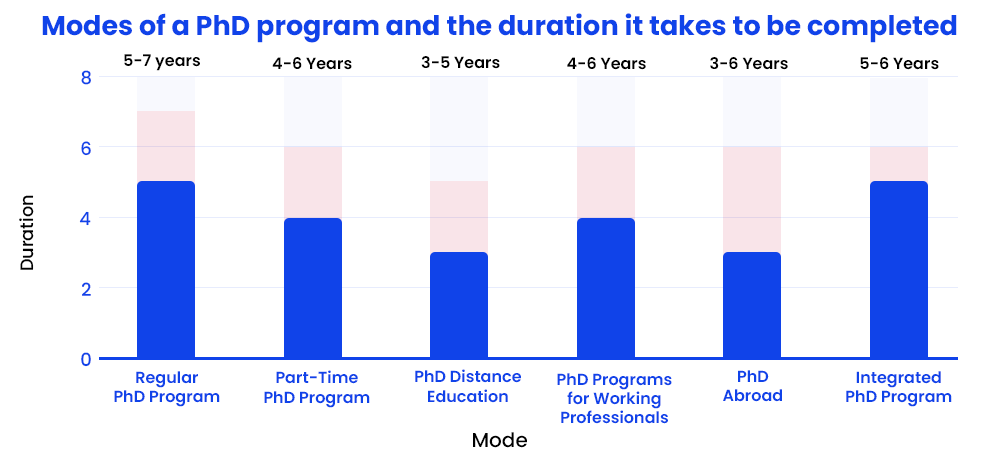
What are the different modes of a PhD program, and how much time will it take to complete?
There are different types of PhD programs available from which you can choose. Some of them are mentioned below.
1) Regular PhD Program
You must routinely attend courses in order to complete a regular PhD program. It takes 3-6 years to finish. To join, you have to pass an entrance exam. You must also give your studies your whole attention.
2) Part-Time PhD Program
Professionals in the workforce can enroll in a part-time PhD program. It involves evening lessons and lasts six to eight years. In addition to needing an NOC from your workplace and at least a year of work experience, you will attend fewer classes. The studies that this program focuses on will assist your firm.
3) PhD Program Online
Online PhD programs are not a viable option since the UGC does not recognize them. One online DBA (Doctor of Business Administration) is an alternative. The duration of this PhD program is three to five years. To pursue it, you are not required to visit a college.
4) PhD Distance Education
The employment opportunities for distance PhDs, also known as distance doctorate programs, are equivalent to those of full-time PhDs. They take three to five years to finish. To apply, you must have five or more years of work experience and a graduate degree.
5) PhD Programs for Working Professionals
Pursuing a PhD while holding a full-time job might be difficult. Numerous universities provide flexible programs, i.e., PhDs for working professionals, to assist working individuals in juggling their studies and jobs. A master's degree with at least 60% is required.
6) PhD Abroad
Getting a PhD abroad is quite possible and takes three to six years. Entrance tests such as the GMAT, SAT, GRE, TOEFL, or IELTS must be passed. These programs are offered by prestigious universities in the US, UK, Germany, Australia, Japan, Canada, Singapore, and France.
7) Integrated PhD Program
A master's and a doctorate are combined in an integrated doctoral program. It takes five to six years to finish. Immediately following your bachelor's degree, you can apply.
|
Top PhD Specializations for Working Professionals | |
What do we learn in the first year of a PhD program?
The beginning of a PhD focuses on finding your base as a researcher and understanding current scholarship related to your topic. You'll have initial meetings with your supervisor to discuss a plan based on your research proposal.
The first step is likely carrying out your literature review. With your supervisor's guidance, you'll survey and evaluate existing scholarship. This helps situate your research and ensure originality. Your literature review will provide a starting point for your own research and gathering of results.
This could involve designing and implementing experiments or working with primary sources. The year may end with an MPhil upgrade. PhD students initially register for an MPhil degree and are then upgraded to PhD candidates upon making sufficient progress.
You'll submit material from your literature review or a draft of your research findings and discuss these with department members in an upgrade exam. If all goes well, you'll continue your research as a PhD student.
What do we learn in the second year of a PhD?
In your second year, you will focus on core research. This varies by field but involves gathering results from experiments, archival research, or surveys. As your research progresses, you will develop your thesis and may start writing chapters for your dissertation.
Regular meetings with your supervisor will continue. They will check your progress, give feedback, and review your drafts. The second year is crucial for your growth as a scholar. You'll be familiar with current research and start collecting significant data or insights.
However, you won't yet face the intense task of finalizing your dissertation. This is an ideal time to present your work at conferences, gain teaching experience, or select material for publication in academic journals.
What do we learn in the third year of a PhD?
The term "writing-up phase" refers to the third year of a PhD program. Your primary responsibility during this period is to gather your findings and transform your thesis into a dissertation.
But things aren't always clear-cut. PhD students in their last year may still be conducting extra research, acquiring data, or optimizing experiments. If you dedicated a portion of your second year to professional growth, this is typical.
Depending on their enrollment conditions and financing, some students finish their dissertations in full or in part during their fourth year. You will eventually have to draft your thesis and turn in your dissertation.
Your supervisor will review your final draft and provide feedback on when it's ready for submission. The viva voce oral test is the last one, where you'll talk about and present your thesis with both internal and external examiners. For a PhD, this is typically the only evaluation. You'll have finished your PhD after you pass.
What is it actually like doing a PhD?
All about Research
- As a PhD researcher, you’ll spend most of your time researching. This involves many different activities.
- You might be in the lab or library, monitoring experiments, or reviewing literature.
- Your PhD could also take you to archives or special facilities to examine data or rare materials. You might even spend time at a research center or another institution.
- Research isn't a solitary activity. You'll regularly discuss your work with your supervisor. You may also collaborate with other students, especially if you're in a larger lab or workshop group.
- Even if your project is more individual, you might work with others on joint projects or help organize events and presentations. Many universities have internal presentations and discussion groups. These are great for meeting other PhD students in your department and giving feedback on each other’s work in progress.
Work with a Supervisor
Every PhD researcher has a minimum of one academic mentor. During your PhD, they will be your primary source of assistance. Although your supervisor hasn't previously studied your specific topic, they are experts in your research field. This guarantees the uniqueness of your project. Consider your mentor a guide rather than an instructor.
You are now an autonomous academic as a PhD candidate. For the first time, you are delving into uncharted territory in your field. Your supervisor is skilled at identifying possible problems and has worked on sophisticated research projects before.
As you work on your thesis, they will hear your thoughts, make suggestions, and show you support. Each university and project has a different supervision arrangement: Supervisors in Science and Technology frequently oversee larger research initiatives, including several PhD students and researchers. In the humanities and arts, supervisors' research is more distinct from that of their pupils.
Even though they may oversee many PhD studies, each one is unique. PhD candidates frequently have two or more supervisors. One directs your scholarly investigation, while the other oversees the management of your doctorate.
Meetings to discuss your work and advancement will be held on a regular basis. Your supervisor will help you get closer to finishing your PhD by providing comments on your work. They will assist you in selecting an external examiner, read your final dissertation draft, and, ideally, join you in celebrating your accomplishment!
You get an opportunity for professional development, networking, and communication:
- The PhD has historically been thought of as a training program for jobs in academic research.
- It frequently offers chances to pick up new abilities and experiences that are crucial for an academic resume. Scholars are not limited to researchers. In addition, they oversee PhDs, manage departments, and instruct students. These days, a PhD is seen as a more adaptable degree. Not every doctorate holder holds a position in higher learning.
- Many pursue jobs in their field of study or make use of the sophisticated research techniques they acquired while pursuing their PhD. This is increasingly reflected in PhD programs. Many place a strong emphasis on employable skills or offer instruction to support students in communicating and using their findings outside of the classroom. Thus, a PhD involves more than merely conducting research and composing a thesis.
You will probably perform all of the following while pursuing your PhD:
- Publish Your Work: Besides presenting your research, you may get the chance to publish work in academic journals, books, or other media. This can be challenging. Your work will be judged by the same high standards as other scholars and will usually go through extensive peer review. But it’s very rewarding. Seeing your work in print is an incredible validation of your PhD research and a great boost to your academic CV.
- Teaching: PhD researchers often get the chance to teach. This usually involves leading small group sessions for undergraduates, demonstrating methods and experiments, and providing mentoring. This work is usually paid and often includes formal training and evaluation.
- Conference: You will be the pioneer of your area as a PhD student, carrying out unique research and producing novel findings. This attracts the attention of other academics and qualifies your work for presentation at conferences. Attending conferences is beneficial no matter what your professional objectives are. You'll start to establish yourself as an authority in your subject, get feedback on your results, and improve your public speaking and presentation abilities. Moreover, conferences offer fantastic chances to network with academic experts and other students.
What if a 5–7 year PhD doesn't fit your timeline?
An Online DBA (Doctor of Business Administration) program is a doctoral option designed for professionals. Like any PhD, you get a ‘Dr.’ degree, but the program is completed online within 3 years, which could take up to 5 years in the longest time frame possible, without moving or stopping your career. It is most appropriate for those who seek recognition as leaders, not researchers.
Where to get the Online DBA?
Here are the list of universities that offer an Online DBA program that is offered by accredited and recognized universities:
|
Universities Offering DBA |
Specialization |
Program fees |
|
INR 6,00,000 | |
|
INR 10,65,000 | |
|
INR 4,50,000 | |
|
INR 7,15,000 | |
|
INR 6,50,000 | |
|
INR 7,50,000 | |
|
INR 7,00,000 | |
|
INR 6,00,000 |
Conclusion
A Ph.D. program in India usually takes 3 to 6 years to complete and can be extended up to 8 years if your university allows it. The duration depends on factors like discipline, research area, progress, and university rules, and the fees depend upon various factors such as university, program, and many more. However, fees of government colleges are still less than in comparison to the private colleges of a PhD.